Blog Archive

Tuesday, April 24, 2012

The strength of doubt.


It is often in discussion about fringe ideas that the following type of statements are made; "science doesn't know everything" or "everyone used to think the world was flat". These are often presented as bolstering the claims put forward, or attacking my critique of certain suggestions that are (thought to be) physically impossible. I do my best to not dismiss these statements as the appeal to credulity that they are often presented as and see them instead as an expression of the desire to expand knowledge.

When taken seriously we can see that of course science doesn't know everything. It hardly knows anything. But this isn't some secret it is an important aspect. Science is a way of knowing, not a body of knowledge. The body of knowledge that is associated with it is a collection of observations and logical constructions to be drawn upon but are by no means science. Alone on an island with no access to this information you would be able to perform basic science.

The second type, about everyone knowing that the earth was flat etc, always strikes me as funny. The observational data from those that tested their beliefs against the world has shown that it is round for thousands of years. It was only when science was not performed that it was thought otherwise.

At times the use of Einstein to replace Newton is put forth as the suggestion that we don't know anything and whatever fresh bullshit is being put forth is true. I like to take this and use it to fertilize ideas rather than allowing the person to think it fruit. When a new theory overturns old, we do not dismiss the old version. Instead we learn it's limits and the new idea is some form of refinement. At least in the case of scientific ideas. If only one is based on observation and experiment then it may well overturn another showing it to be very wrong.

But even the flat earth model has a use. If you are calculating the physics of a baseball game, or car crash you can treat it as Newtons physics on a flat earth. Quantum effects, relativity, and the curvature of the planet are not going to be needed for getting results. This information becomes relevant if you refine your scale enough or if you expand your view enough.

If we can say anything about the world it's this; We create a gestalt hallucination based on faulty sense data and feedback mechanisms, this is guided by events beyond our control, and thrown together in brains evolved not to grasp the universe in her majesty, but to grasp a stone to kill a rival or a lion. Still, we have developed a system of charting beyond our own individual failings. We can turn this tool upon anything and have used it to rid the world of horrific diseases and shorten the distance around the world to a days travel. We have used it to probe the very stuff of reality and find it stranger than words can describe. That our view is narrow and our comprehension limited is of no doubt, but it grows. There are many things beyond our purview, and many more that we may never come to know that we don't know.   

Tuesday, April 10, 2012

How we support ideas


Richard Feynman explains some of the key points to scientific reasoning.  This is the best way that we have for evaluation of claims.  If you notice it is somewhere between induction and abduction, but the key point is the testing against experiment.  This testing is how we form impressions of the world, that we can say are correct (for a given value of correct).


He also demolishes the appeal to authority, citing the test against evidence as the only arbiter of fact vs fiction.

He then goes on to discuss the idea of proving or disproving something.  And states the pragmatic idea: "We must always try to guess the most likely explanation keeping in the back of the mind that if it doesn't work, we must discuss the other possibilities."

The importance here is that we can think of this process as an effort to define and eliminate types of ignorance.  We can attempt to explain the world, but our statements of absolute certainty must be reserved for what has been repeatedly shown to be false. Other ideas must be discussed in a manner of what the limits to the information we have are, and what test would prove our idea conclusively wrong.

This is not to discount positive evidence or say that we can know nothing, it is only to temper our claims of certainty with doubt.  And while there may be some indication that we humans favor the certain over the uncertain and flock then to demagogues, we can train ourselves through understanding and vigilance to resist this baser impulse.

This link contains some great quotes from scientists as they struggle to define the term science. Which is the process that I attempting to describe here. An idea that is so simple that it almost refuses clear definition. But following through on defining terms so that we may be understood is a goal of those that wish to discuss things clearly, without retreating to fallacies or vague assertions.


Thursday, April 5, 2012

Triumvirate

Rhetoric, Grammar, Logic.

To speak well, To write well, To think well.

For some reason these were given equal weight in the system. However mastery of either of the first two ( or both) will allow you to fake a competency in many things mastery of the third will allow you to attain that competence. Of course skill in communication and the beautiful assembly of language are still to be valued as they will better allow the expression and transition of ideas.

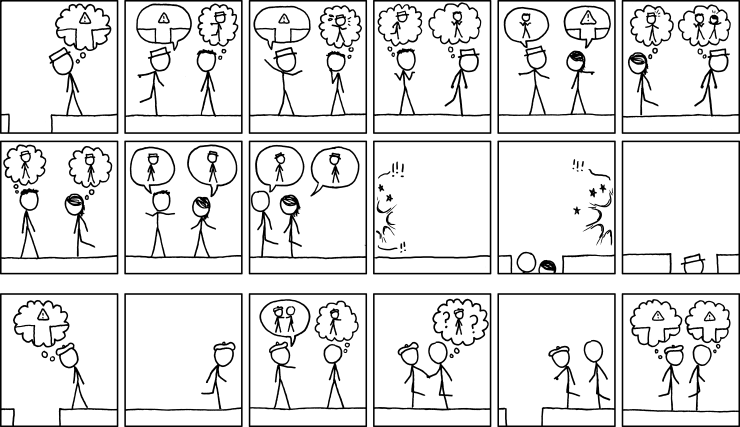
A quick note on communication from Randall Munroe


  http://xkcd.com/1028/


Tuesday, April 3, 2012

Value of evidence


http://www.youtube.com/watch?v=pk7jHJRSzhM

Sam Harris asks an interesting question. "If someone doesn't value evidence, what evidence are you going to provide to prove that you should value it"

My personal opinion is that most people do value evidence, but only so far as it supports their world view. They will dismiss evidence that conflicts with their view*.  The key here is to shape the ideas to fit into their preconceptions or to forcibly annihilate those preconceptions. If you wish to offer an argument it seems like a good idea to start with premises that the other parties can accept. If they reject your premises they have no reason even to listen to your argument.  IFF they accept your premises and they reject your valid argument from those premises then you no longer need consider them a rational participant in the discussion.

Caution should be used here, and you should listen to the critiques that they offer of your argument. A refusal to listen to the critique or a disagreement over the consequences of certain ideas being true, is not a good reason for ending a discussion.  Accusations of irrationality can fly in heated debate, and it is important to remain calm and only make claims that are grounded in evidence. Making assessments of the other persons rationality, intelligence, or motives can border on personal attacks and should be avoided. It is only when they abandon the willingness to either commit to their own ideas and the outcomes of them, or listen to any offer of alternate explanation with either an equal or better fit to the facts at hand that you can say that they behave irrationally from evidence and not from personal feelings.


_____________________________________________________________________

*This isn't exactly valuing evidence it is succumbing to confirmation bias, but there is a wedge strategy that can be employed, and so I didn't want to distract from my next point.


Wednesday, March 21, 2012

The Nature of Discourse and Argument Part 5


Types of Logic

Logic is the process of making reasons. It is important to distinguish this from making excuses or for attempting to explain something. It has three main forms: Deduction, Induction, and Abduction. These have varying levels of certainty and are useful in different circumstances.  In all cases the argument (remember what I mean by this term) can either be well constructed with each step leading to the next or not well constructed with missing or incorrect connections between ideas.  The measure of these to states is called Validity, which deals with the form of the argument.  Invalid arguments are most often either incomplete or fallacies.  


Deduction: Proceeding only from known information to that which can be directly derived from it.  This deals with the concept of necessary truth, that is things that, given certain other things, must be true.  It is through the conditions of validity that we gain our grasp on what must be necessarily true (or false) based on premises. If you have a valid argument with true premises than the conclusion must be correct.  The technical term used for the conclusion is "sound" for correct or "unsound" for incorrect.   Mind your P's and Q's 


Induction:   Making a  "reasonable" extension from what is known to what is unknown.  Induction is a probability based method of reasoning.  Where, unlike deduction, things are not 'necessary" but assigned varying degrees of certainty or likelihood. The advantage we have over deduction is that we can expand our knowledge base because we are moving often from specific cases to a general case.  If things seem to fit with our inferences they can be said to be "cogent" and assigned a likelihood (depending on the amount of data and strength of connections).  If things seem to not fit with inferences they can be said to be "not cogent".  These terms are the equivalent of sound and unsound in deduction.

Abduction: Basically this is telling a story that seems to fit with the facts. 

Here is an example of abduction.   

There is no pudding in the fridge.   We attempt to say why, by considering that someone ate all the pudding.  This seems like a reasonable explanation.  But first we should consider a few things. What other explanations are there, how about these two. The pudding was bad so someone threw it out; There was never pudding in the fridge.      Here we have three equally reasonable explanations, given the facts at hand. If we get more information then perhaps one or all of them will become less reasonable. For instance, if we ourselves put pudding in the fridge then we can dismiss #3 If we check the garbage and find the pudding #2 grows more likely.     If it is a new fridge still in the store we can bet that #3 is the most likely.


We could also postulate some form of pudding eating phantasm or perhaps suggest that Bill Cosby comes out of the television and eats it while we sleep.  The ability to tell a story the describes the events is simply the starting place.  How we attempt to support our claims is what really matters.

Now the state of pudding in the fridge is perhaps not your main concern (perhaps you've already had dessert).  But the methodology is one to be aware of. 


These three methods of reasoning are useful under differing circumstances and we should have at least a passing familiarity with all three. I am hoping that this basic guide will assist in differentiating the type of reasoning that is being used (if indeed reasons are being given). The evaluation of arguments is based partially on general knowledge and ability to apply these various forms at the appropriate times. 


________________________________________________________________
Additional Reading

http://plato.stanford.edu/entries/peirce/#dia
http://www.fibonicci.com/logical-reasoning/
http://commonsenseatheism.com/?p=3703
http://changingminds.org/disciplines/argument/types_reasoning/types_reasoning.htm
http://butte.edu/departments/cas/tipsheets/thinking/reasoning.html

The Nature of Discourse and Argument series on this blog
Part 1
Part 2
Part 3
Part 4

Friday, March 16, 2012

Grounding of Morality

I hadn't heard of Shelly Kagan before but this is interesting:


http://www.youtube.com/watch?v=SiJnCQuPiuo&feature=related

Lane uses a definition of god here that makes it the basis for moral values by describing it with moral values.  It seems like in this case we could then remove the god and leave moral values as the basis for moral values.  I am not saying that I think this is sound, just that by the reasons he is using I can see no real objection to doing so.

The real question that Lane seems to ask is; How if they not universal can we say rights and ethics and morality truly and objectively exist?  I must recycle my previous answer that I think we tend towards emergence.  Replace ethics with consciousness or oxygen based metabolism and you should see the point I am trying to make.  It may simply be a part of our nature.  Conversely it may be a construct that could have developed differently under different circumstances.  We then have to wonder if the circumstance is unique to humans, unique to certain types of consciousness, or unique to conscious beings of any kind.

Some of my own ideas from prior to watching this debate

http://newsoldsandopinions.blogspot.com/2012/02/objective-values.html

http://newsoldsandopinions.blogspot.com/2012/03/what-is-basis-for-rights.html

http://newsoldsandopinions.blogspot.com/2012/02/pragmatic-empiricism.html

http://newsoldsandopinions.blogspot.com/2012/02/re-arguments-for-existance-of-god.html

 from Game Theory

http://thisorthat.com/blog/why-the-joker-and-not-batman-is-the-savior-of-us-all

Thursday, March 15, 2012

2 ways of moving from a premise

You have a premise you can reason out what is necessary for the premise to be true ( either the premise is a direct consequence or shares ascendant cause with these ideas), and you can reason out what is a consequence of the premise. While these two types are in most respects the same, I find that it is useful to address the time domain; where the first would be hints already in place and the later being things that follow after. This distinction is one of personal preference for addressing causal determinants.